
Franklin County Criminal Records
A criminal court record in Franklin County is the court case file kept after a complaint, citation, information, or indictment starts the case. The record can begin with a charge and bond entry, then grow as arraignment, pretrial hearings, motions, plea negotiations, trial settings, sentencing, review hearings, payments, warrants, and appeals are added. For a closer look at the first charge filed after an arrest, use Arrest Records & Charges. For the broader case index across civil, family, probate, traffic, and criminal files, use Court Records.
Franklin County uses Kentucky's unified court system. The Circuit Court is the trial court of general jurisdiction and handles felony criminal cases. The District Court handles misdemeanors, traffic misdemeanors, preliminary felony hearings, juvenile matters, and related lower-level criminal events. The Office of Circuit Court Clerk manages records for Circuit, Family, District, and Business courts in the county, so the clerk is the local record office even when the case is a District Court misdemeanor.
| Court or Office | Criminal record role | Contact |
|---|---|---|
| Franklin Circuit Court | Felony prosecutions, felony sentencing, appeals from District Court | 222 Saint Clair Street, 502-564-7013 |
| Franklin District Court | Misdemeanors, traffic misdemeanors, preliminary felony hearings | 222 Saint Clair Street, 502-564-7013 |
| Circuit Court Clerk | Case files, copy requests, payment records, stored file routing | Kem Marshall, 502-564-7013 |
Find Franklin County Criminal Cases
The main public online route is KYeCourts Public Court Records. Guest access is free, but the public entry point starts behind verification and some CourtNet functions are for registered users. Hearing-date checks can also use the KCOJ Docket Information portal, which accepts county, division, date, courtroom, and subdivision fields. If the online case page is incomplete, the Kentucky Court of Justice instructs users to call or visit the Circuit Court Clerk for case-file copies and stored-file information.
- Start with KYeCourts guest access and search by the defendant name or known case number.
- Confirm that the county is Franklin and check whether the division is Circuit or District.
- Open the case detail and read the charge, docket, plea, disposition, and sentencing entries together.
- Use the KCOJ docket portal for future hearing dates by selecting Franklin County and the correct division.
- Request certified copies through the Circuit Court Clerk when a record must be used for court, licensing, employment, or another formal purpose.
The official KCOJ records guidance notes that older files may be at the clerk's office, at a records facility, or destroyed under retention schedules. If a stored criminal file remains available to the public, the clerk identifies the storage facility and provides case and file locator numbers. That fallback matters in Franklin County because online access does not prove that no record exists.
Franklin Criminal Case Flow
Criminal records should be read as a timeline. A felony may start with an arrest, citation, complaint, or preliminary District Court event, then move into Circuit Court after indictment or other felony filing. A misdemeanor usually stays in District Court. Each step may create a docket entry, order, payment entry, bond condition, or warrant notation.
Case flow: Charges Filed › Arraignment › Pretrial and Motions › Plea or Trial › Disposition › Sentencing
| Stage | What the record may show |
|---|---|
| Charges filed | Complaint, citation, information, indictment, statute reference, case number, and bond activity. |
| Arraignment | First formal court appearance, plea entry, counsel status, and next hearing date. |
| Pretrial and motions | Orders, continuances, discovery disputes, suppression motions, and plea discussions. |
| Plea or trial | Guilty plea, not guilty finding, verdict, amended charge, or dismissed count. |
| Disposition and sentence | Final outcome, jail or prison term, probation, fines, costs, restitution, and review dates. |
The manifest source for the KRS Chapter 431 criminal procedure statutes provides useful context for Kentucky criminal procedure and post-case relief.
That statute source is most useful when a Franklin County criminal record includes later expungement, dismissal, or post-disposition entries.
What Criminal Court Records Show
Franklin County criminal court records can include both party data and event data. The party side identifies the Commonwealth, the defendant, attorneys, judge, and court division. The event side shows the filing date, charge entries, arraignment, motions, hearings, plea, disposition, sentence, fines, restitution, bond entries, warrants, and appeals. Some documents may be view-only or unavailable from guest access, and certified copies usually require a clerk request.
| Field | What it means |
|---|---|
| Case number | Kentucky case identifier, usually showing year, court or case category, and sequence. |
| Court and division | Circuit, District, or Family division tied to the hearing or case record. |
| Charge | Offense name, statute reference, count, and any amended or reduced charge status. |
| Plea | Defendant's formal answer, such as guilty or not guilty. |
| Disposition | Outcome of the case or count, including guilty, dismissed, acquitted, or other final action. |
| Sentence | Jail, prison, probation, fines, costs, restitution, or other court-ordered terms. |
| Docket entries | Hearings, motions, orders, continuances, warrants, bond changes, and review dates. |
Note: A docket date is not the same as a final outcome; always check the disposition and sentence entries before drawing a conclusion.
Charges and Convictions
A Franklin County criminal court file can show charges that never became convictions. A charge is an accusation filed into a case. A conviction is a guilty plea, guilty finding, or verdict that produces a criminal judgment. Dismissed charges, reduced counts, and amended charges should be read count by count, not as one broad case label.
| Point | Charge | Conviction |
|---|---|---|
| Meaning | Accusation or filed count | Final guilty outcome on a count |
| Where it appears | Complaint, citation, indictment, docket, jail or bond record | Disposition, judgment, sentence, probation, payment entries |
| Risk of misread | May be dropped, amended, dismissed, or reduced | Still must be matched to the exact charge and date |
The Kentucky Attorney General prosecutors directory identifies the Commonwealth's Attorney for the 48th Circuit and helps distinguish felony prosecution from county-level legal functions.
That prosecutor listing supports the felony case context, but the court record itself remains the source for the charge outcome.
Prosecutor and Defense Routes
Kentucky uses Commonwealth's Attorneys for felony and serious criminal prosecution by judicial circuit. The Attorney General directory lists Hon. Larry Cleveland as Commonwealth's Attorney for the 48th Circuit: Franklin, with an office at the Franklin County Judicial Center, 222 Saint Clair Street, 3rd Floor, Frankfort, KY 40601, phone 502-564-4741. The Franklin County Attorney page lists Max Comley as County Attorney at 222 St. Clair Street, Suite 2007, P.O. Box 73, Frankfort, KY 40602, phone 502-875-8745, with Monday through Friday hours from 8:00 a.m. to 4:30 p.m.
The prosecutor is not a defense resource. Indigent-defense questions route through the Kentucky Department of Public Advocacy, including the Frankfort Trial Office listed in the research. Prosecutor pages may help identify who files or handles charges, while the criminal court record shows what the court accepted, amended, dismissed, or sentenced.
The manifest source for the Franklin County Attorney page gives the local county attorney contact and role.
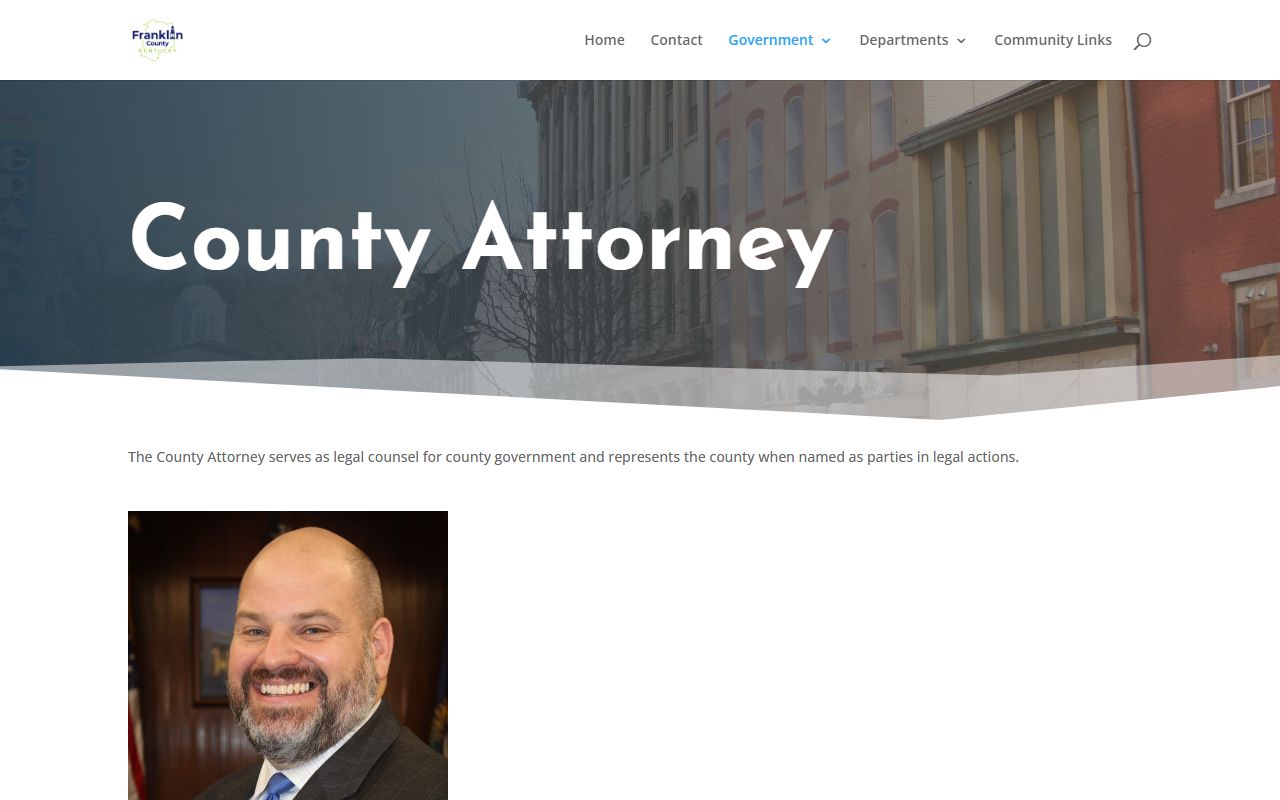
Use that office information for local-government and county-attorney context, not for certified criminal case copies.
Public Access and Limits
Kentucky public-record access starts with statutes such as KRS 61.870, which defines public records and resident terms, KRS 61.872, which covers inspection requests, and KRS 61.878, which lists exemptions. Court case access in practice starts with KYeCourts, KCOJ dockets, and the Circuit Court Clerk rather than a county-created criminal database.
Restricted criminal records include juvenile matters, sealed records, expunged records, adoption-related content, mental health information, personal identifiers, and law-enforcement investigative records when an exemption applies. The research identifies KRS 431.073 for qualifying felony expungement and KRS 431.076 for charges dismissed with prejudice or resulting in acquittal.
| Record status | Public effect | Practical route |
|---|---|---|
| Sealed | Hidden from ordinary public viewing | Access may require party status, attorney access, or court order. |
| Expunged | Removed from public access under a qualifying order | Eligibility depends on statute, charge, disposition, waiting period, and record history. |
| Redacted | Public file remains, but private data is withheld | Expect removal of SSNs, minors' names, financial account data, and medical details. |